
Where Payson Previous Residents Appear
Previous residents of a Payson address are found by matching a stable parcel or legal description to sources that cover separate eras. The County Recorder supplies the legal chain. Directories, census schedules, newspapers, cemetery records, and permits add dated people or building context. A map can show that a street or structure existed, but it cannot name every household.
| Source | Years It Covers | Where Held | What It Shows |
|---|---|---|---|
| Recorder index and books | 1870 to present in online description | Utah County Recorder, books, microfilm | Recorded parties, instruments, legal descriptions |
| FamilySearch deed catalog | 1850–1995 | FamilySearch images and indexes | Early conveyances and county deed material |
| R.L. Polk directory leads | 1891, 1901–02, 1904–05, 1911 | Library, genealogy finding aids | Named households and street listings |
| Utah city directory lead | 1973 | Digitized or commercial image access | A later household snapshot |
| Sanborn, newspapers, cemetery | 1890, 1893–current, 1893 onward | LOC, library, city records | Building, notice, death, and place context |
| Permits and census | 1998 onward for listed cross-checks | Payson Development Services and census sources | Project dates and household comparison |
Start with the Recorder for title history, FamilySearch for early county material, and the local library for directory, newspaper, yearbook, and house-history leads. The listed directory years are real collection leads, not an uninterrupted annual run. Exact local shelf call numbers and reverse-directory holdings require reference-staff confirmation.
Anchor Payson Previous Residents to a Serial
Begin with the current parcel, not a broad search for a surname. The Utah County address form can locate a Payson candidate by number, direction, street, street type, and City/Location. The Parcel Map then supplies the polygon, serial, city choice, and legal-location clues. Copy the situs address, serial, subdivision or plat, and legal description into a dated research note.
Older records may use a block and plat, section-township-range description, or a different street label. Test the serial in property, abstract, and book/page searches. The modern mailing address is a useful lead, but the legal description is the better bridge when the road name or municipal line has changed.
Do not confuse the map’s historic-date control with a deed date. The Parcel Map warns that the historic date reflects when an entry entered the online property system, not necessarily when the instrument was recorded.
Read Payson Previous Residents in Recorder Time
The Utah County Recorder’s public explanation describes records from 1870 forward. The alphabetical index is handwritten from 1870 through January 1978, then computerized from January 1978 onward. Abstract material is handwritten or typed through September 1985, with computerized or online coverage beginning in May 1980. Those periods overlap, which makes a second search route worthwhile when a name or address does not appear.
The Utah County Recorder recording search shows the entry/year and date-range route. The captured view is a useful first stop for a known recording period, with image access dependent on the record and the legacy portal.
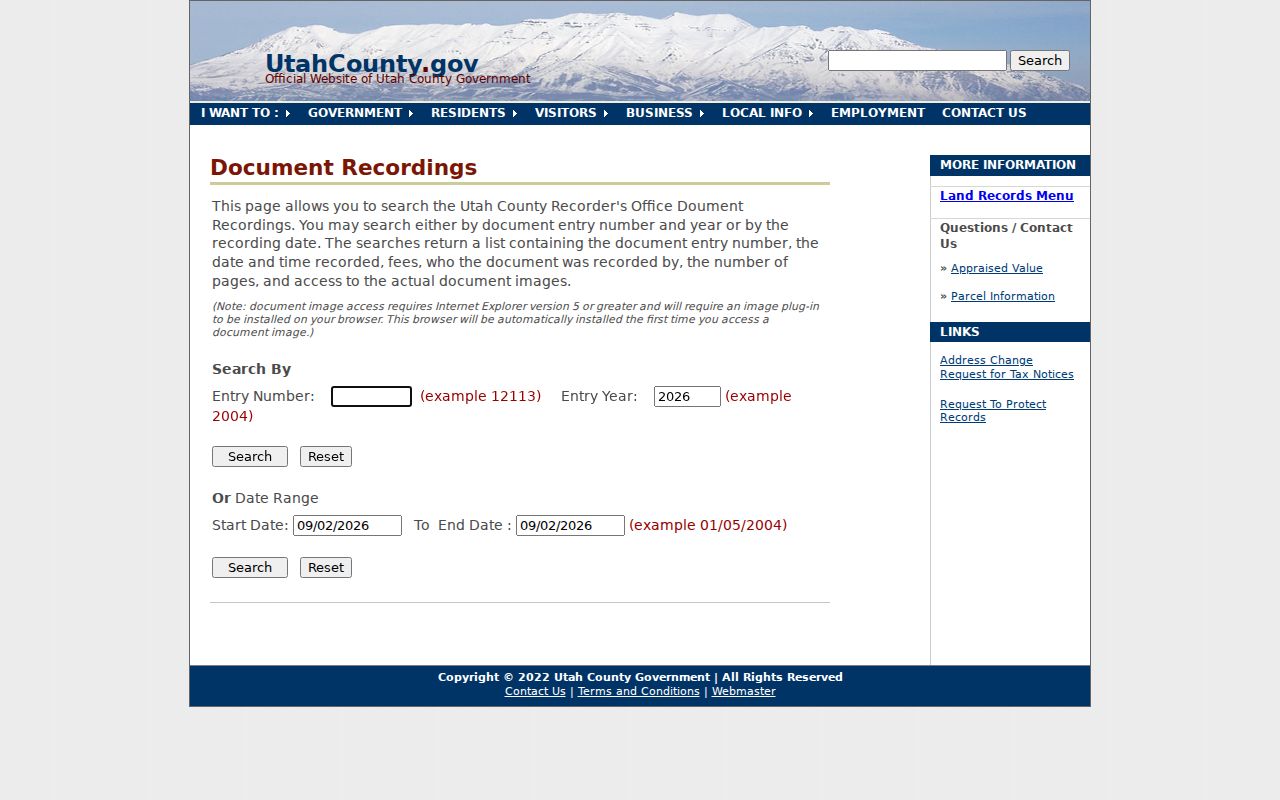
A search result is an index lead. Check the image, book, page, abstract, and related serial, or ask the counter for the correct copy path when an old image will not render.
Trace Past Payson Residents Through Deeds
For a Payson house, the deed chain starts with the current parcel serial or legal description and moves backward through the Utah County Recorder’s index. A current assessor name is only the first candidate. The instrument tells whether the party was a grantor, grantee, lender, trustee, release holder, or another participant.
- Pull the current parcel serial, situs, and legal description from the assessor and GIS records.
- Find the current owner’s purchase instrument in the Recorder index by name, serial, abstract, or document type.
- Read the seller as a prior party, then search that party and the same legal description for the preceding conveyance.
- Repeat backward while recording every entry number, year, recording date, instrument, book/page, serial, tie, and release.
- For the earlier period, move to handwritten indexes, abstracts, deed books, microfilm, FamilySearch images, or State Archives help.
- Grantor
- The party transferring an interest in the instrument.
- Grantee
- The party receiving that interest.
- Chain of title
- A linked sequence of recorded transfers for the same land.
- Legal description
- The formal land description used to identify the parcel when a street address is unclear.
- Criss-cross directory
- An address-based directory that links a house number or street to a dated person listing.
- Enumeration district
- A census area used by the enumerator, which helps locate a household when a street name or number is hard to read.
Utah County says it does not perform a public title search or interpret legal documents. A chain assembled for house history is not a title opinion.
Payson Party History and Past Residents
The Recorder party-name search has a KOI Group choice that narrows document categories. A result can include a warranty deed, mortgage, release, tie, lender, company, or incorrect tie. That is why a party-history line should be classified before a name is called a past resident.
The research inspection of Payson Building and Loan Society includes 1973 release and mortgage entries tied to Payson City lots, later entries, book/page references, and one incorrect tie note. It shows the value of reading the instrument and legal description instead of treating a sorted name list as a household history.
See the Utah County grantor and grantee search for the party-history route. The captured view shows the party-history fields used to start that comparison.
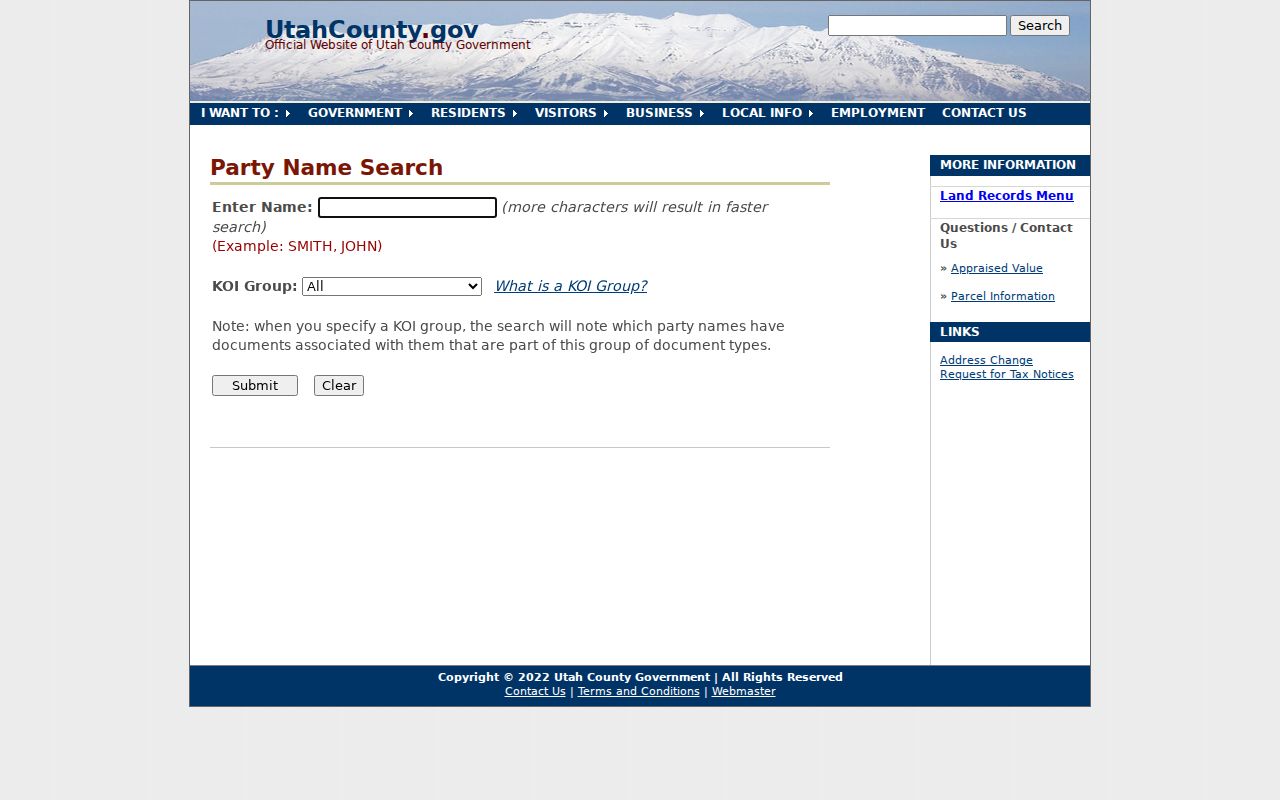
Use a party result to find the next document, then confirm its date, role, parcel, and legal description in the official record.
Use a Payson Deed for Past Residents
A recorded document detail page shows the kind of fields that make a deed useful for a backward trail: entry and year, recording date and time, pages, instrument date, consideration, KOI, receiving party, tax address, grantor, grantee, serials, tie or release references, and abstract description. The fields identify a record event. They do not by themselves prove that a named party lived at the address.
The Utah County sample deed includes an entry from 2025, linked serials, a tie to an earlier entry, and a legal description referring to a public road. The captured page also warns that a taxing description is not for legal documents.
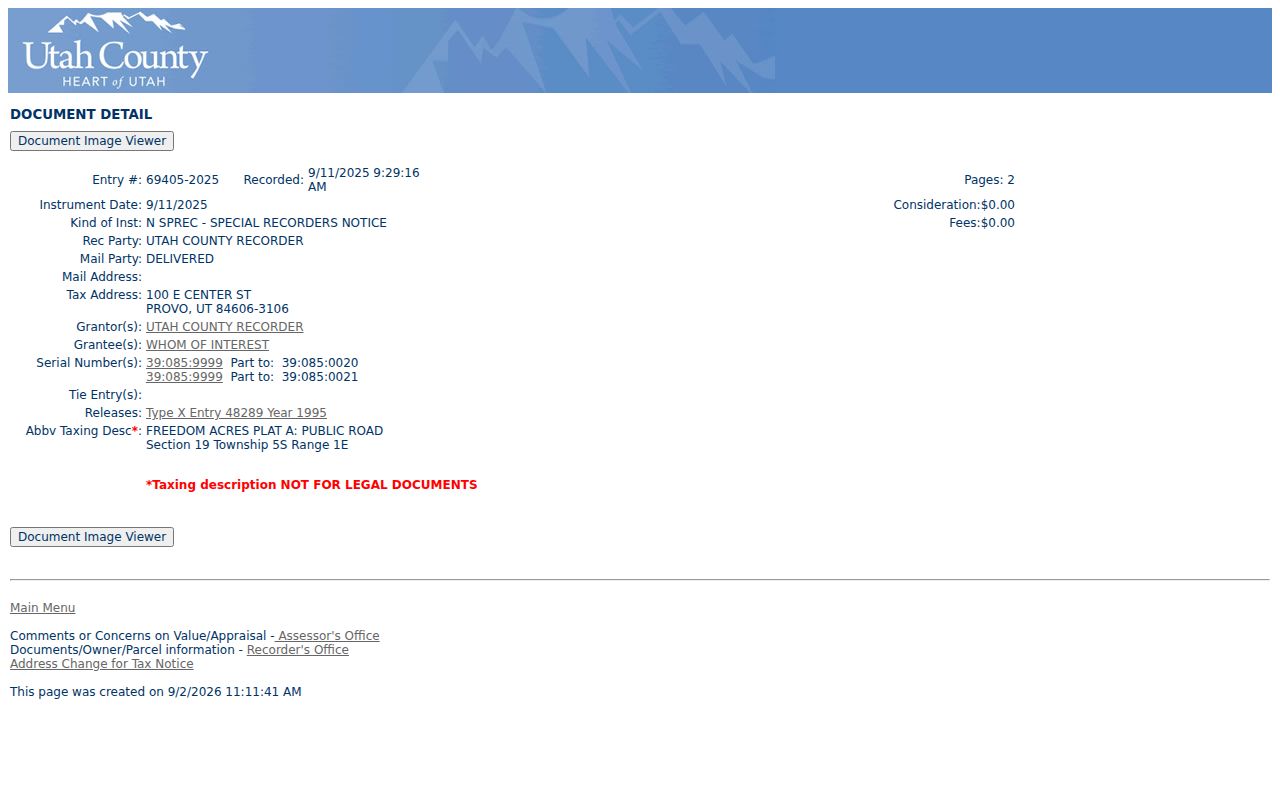
For a house-history file, copy the record’s identifiers and request an official copy when the image or wording matters. The Recorder’s published schedule lists $1 per recorded-copy page and other recording, plat, certification, and processing charges, so confirm the current amount before ordering.
The Utah County recording-fees page gives the office’s current fee context. The captured view helps identify the copy and certification charges to verify before ordering.
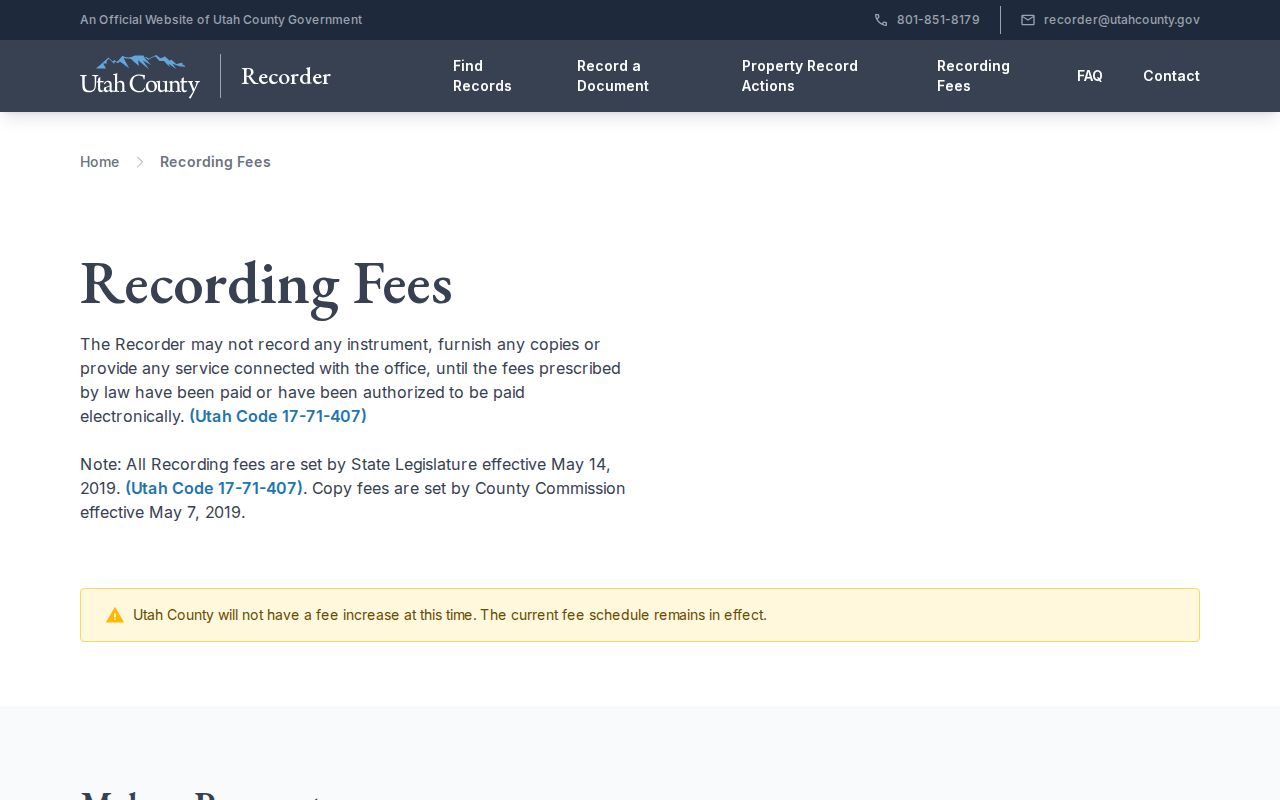
Fees matter when a promising index entry needs a readable copy, especially for an older page or a linked plat.
Past Payson Households in Print
Previous residents can be separated from past owners by pairing a directory address with a census household and an independent local record. R.L. Polk’s Provo City and Utah County Directory has Payson sections identified for 1891, 1901–02, 1904–05, and 1911. A separate Utah City Directories collection has a 1973 Payson lead. These are snapshots, not a complete annual run. Use the Payson city directory collections page for the collection details.
Run the household layer as a short process:
- Search the printed or digitized directory by street and house number, then by surname if the street index is missing.
- Write the exact year, publisher, page, relationship qualifier, address, and abbreviations such as
rfor residence orbdsfor boards. - Compare the closest census year, noting the enumeration district and the household members shown there.
- Check a newspaper notice, cemetery row, marriage index, or obituary for a separate date or family connection.
The Utah County obituary index is identified at approximately 1874–2010. Payson newspaper leads run from the 1890s into current titles, and cemetery records begin in 1893. These sources can close a timeline after someone moved or died, but they do not establish every address where a person lived.
Lawful use. Previous-resident research in Payson is appropriate for house history, family history, and personal curiosity. Do not use records to track, harass, intimidate, or harm a living person.
Match Old Payson Street Names
The 1890 Payson Sanborn set contains five sheets and supplies a fixed-date view of streets, buildings, and uses before ZIP codes. It is not a title record or resident roll. Pair its labels with the 1891 directory lead, a census schedule, a deed or plat, and a later map before deciding that an old address matches a modern one.
Payson’s dual grid helps explain mismatches. Utah Avenue is 100 N, 900 N also appears as 9600 S, 700 N relates to Arrowhead Trail, and 200 S is 10400 S. Main and numbered streets appear in city materials. Annexation notices add jurisdiction dates, including a Clearwing filing near 3751 W 9600 S on January 2, 2025 and earlier R&C #2 and Pace Industrial Park entries.
If the house falls near the city edge, check the legal description, county map, city plan, and annexation record together. A familiar mailing name can cover a place that was described as county land in an earlier source.
Ask Payson’s History Keepers
The Payson City Library at 66 S Main is the first local call for newspaper microfilm, yearbooks, reverse directories, and a shelf-list check. Its published hours are Monday through Thursday 10 a.m. to 8 p.m. and Friday through Saturday 10 a.m. to 6 p.m.; reference staff can confirm the holdings gap rather than guess at a call number. The library phone is 801-465-5220.
The Payson FamilySearch Center at 955 W 450 S, (801) 465-1349, offers helpers, classes, indexing support, and equipment for digitizing tapes, photographs, slides, books, and home movies. The FamilySearch Utah County deeds catalog shows the online route for the 1850–1995 collection. The captured view illustrates that catalog path.
Account or image restrictions may apply, so original county volumes remain the authoritative fallback. The Historical Society at the Peteetneet facility, 439 W Utah Ave, 801-465-5200, collects local artifacts and records and surveys historic properties.
For older government series, contact the Utah State Archives reference room. For a city or county record that is not posted, use Utah County’s GRAMA request route or Payson’s City Recorder process. A request should name a narrow record series and date range. GRAMA does not override protected records or create a resident list.