
Finding Payson Residents
A Payson residents directory is best treated as a set of clues that answer different questions. A county parcel search can connect a name to land. A deed can show who signed a recorded instrument. A voter search can help a person check their own registration. A city directory or obituary can place a family in an earlier year. None of these records is a complete roll of every person in town, so the strongest search begins with the detail already in hand: a full name, an address, an old street label, a parcel serial, or a date.
Start with the least costly, most direct source. If the clue is an address, use Utah County Land Records and the Parcel Map. If it is a case, use Utah Courts Xchange. If it is a family event, use the Utah Office of Vital Records and Archives routes, subject to access rules. For past residents, pair a directory or newspaper notice with a deed, census, cemetery row, or marriage index. For a missing online result, call the custodian, ask about a counter terminal or older volume, and then make a narrow GRAMA request when the record is held by Payson or Utah County.
- Write down the known name, street, date, middle initial, spouse, parent, parcel serial, or case number before searching.
- Run the Utah County address, name, or serial search, then confirm the parcel in the county GIS viewer.
- Use the Utah voter self-lookup only for the voter’s own status, polling details, or registration question.
- Search the Recorder index for document parties, dates, legal descriptions, and linked prior entries.
- Move older questions to directories, newspapers, cemetery records, FamilySearch, the library, Archives, or a targeted records request.
Payson’s Records Offices
Utah County is the main operating layer for Payson property and recording research. The County Recorder is at 100 E Center St, Suite 1300, Provo, and lists 801-851-8179 and recorder@utahcounty.gov. Its public explanation describes official records from 1870 forward, with books, microfilm, scanned images, and indexes. The Clerk’s elections office is in Suite 3100 at the same street address, with 801-851-VOTE, while marriage functions are listed at 111 S University Ave and 801-851-8109.
Payson keeps the city-level side of the trail. The City Recorder at 439 W Utah Ave handles municipal minutes, ordinances, resolutions, contracts, notices, elections, annexation material, and GRAMA routing. The city page lists 801-465-5205 and general Monday through Thursday hours of 7:30 a.m. to 6 p.m. A city-originated annexation or easement may still be recorded at the county office, so follow the entry number to the custodian that holds the instrument.
Utah County Land Records
100 E Center St, Provo
Property and parcel routes
801-851-8295 Assessor
Search a Payson Parcel
The Utah County Land Records hub is the practical first stop for a current Payson address. Its linked tools include name, address, serial, property, tax, abstract, document, entry, recording, and map searches. The address form asks for number, direction, street, street type, and city or location, with All Records and Current Records Only choices. It does not expose a ZIP field. A name search uses the Last, First Middle format and lets the researcher test all records, current records, or never-valid records.
Search the whole address first. If nothing fits, omit the direction, try a different street-type choice, or use the serial supplied by the Parcel Map. Property searches accept forms such as 411750010, 41:175:10, and 41 175 10. Abstract searches use a shorter serial style. These variations matter when an older entry was keyed in a different format. The county warns that some images depend on older browser technology, so a working index does not always mean a modern image viewer will open.
| Land Records field | Control and Payson use |
|---|---|
| Number | Text field, such as 100, for the address number. |
| Direction | Optional dropdown for a directional prefix or suffix. |
| Street and type | Text plus a street-type choice; test variants for older indexing. |
| City / Location | Select Payson when narrowing the county search. |
| Record mode | All Records or Current Records Only. |
| Name format | Last, First Middle, with all, current, or never-valid choices. |
The Utah County Land Records hub is the source for these search paths. The result is an index lead, not proof that a named owner occupies the parcel.
Note: A county owner name can belong to a trust, lender, company, or tax mailing party rather than a household member.
Payson Parcels on County GIS
The Utah County Parcel Map adds the place layer that a name index cannot supply. Search by address or common place, serial or book and page, owner, PLSS section-township-range, or city. Choosing Payson can zoom the map to the city. The selected parcel can connect a situs address, parcel serial, city or location, legal-description context, value and tax links, and recording links. Map tools include layers, aerial basemaps, measurement, deed points, PDF or print, export, and reset controls.
The map’s historic-date control needs care. Its warning says the date reflects when an item entered the online property system, not necessarily the date a deed was recorded. Treat the viewer as reference material, then check the linked Recorder document for entry, year, parties, instrument type, and legal description. This distinction keeps a historic map view from being mistaken for a title opinion.
The Utah County land-records hub is the source shown in the capture, with the broad property and document routes available to a Payson search.
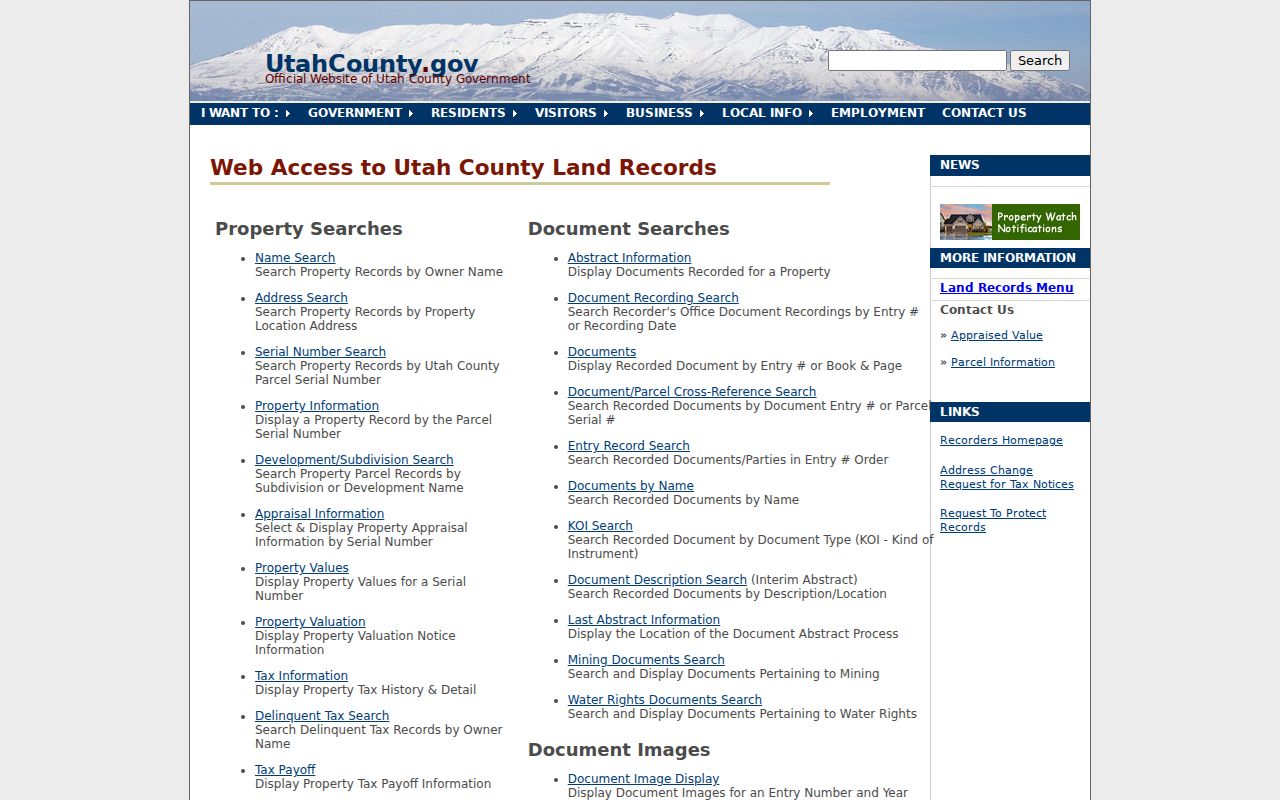
The hub’s many links explain why one search may need a second route. A parcel serial can bridge the address form, map, tax-year view, abstract, and recorded document.
Note: GIS contact is Utah County GIS, listed at 801-851-8000 and ucwebmaster@utahcounty.gov, with a reference-only map disclaimer.
Current Payson Resident Sources
Current resident questions need a source-by-source reading. A property roll describes an owner or tax relationship. A voter product describes registration and election information. A recorder index describes parties to an instrument. A city staff directory describes people in a civic role. The categories overlap, but they do not mean the same thing. Use the table as a routing aid rather than a promise that one source lists every Payson household.
| Source | What it can show | Keeper | Access |
|---|---|---|---|
| Property and tax records | Owner, parcel, tax mailing information | Utah County Assessor / Land Records | Free online index |
| Voter self-lookup | A voter’s status and polling details | Utah Elections | Free, self-use form |
| Recorded instruments | Grantors, grantees, liens, releases, legal descriptions | Utah County Recorder | Free index, copies may cost |
| Municipal records | Minutes, notices, permits, city actions | Payson City | Online or GRAMA route |
| Historical collections | Dated household, obituary, burial, or directory clues | Library, Archives, FamilySearch | Collection-specific |
When the goal changes from a broad directory question to one person, the Payson resident lookup workflow adds court, vital, custody, and identity checks. That page keeps the one-person trail distinct from the parcel and historical routes summarized here.
Payson Resident Trails in the Recorder Index
The Utah County Recorder’s public description says official records run from 1870 forward. The alphabetical index is handwritten from 1870 through January 1978 and computerized from January 1978 onward. Abstract material is handwritten or typed through September 1985, with computerized or online abstract coverage beginning in the overlapping May 1980 period. A gap in one search mode should therefore lead to the other mode, not to the conclusion that a deed is absent.
Use the document, party, KOI, abstract, entry, and recording tools together. A grantor is the party conveying an interest; a grantee receives it. A release, mortgage, tie, or incorrect-tie entry can name a lender or connect a prior record without showing who lived at the address. The Recorder’s sample detail can expose entry and year, recording time, instrument date, KOI, party roles, tax address, serials, tie or release references, and legal description. Request an official copy when the exact wording matters.
One concrete example is the Recorder’s public records explanation, which describes books, microfilm, scans, indexing methods, and copy routes. It gives the directory user a way to move from a search result to the office’s actual record practice.
The Utah County Recorder records guide shows the public explanation used to distinguish an index, an image, and a copy request.
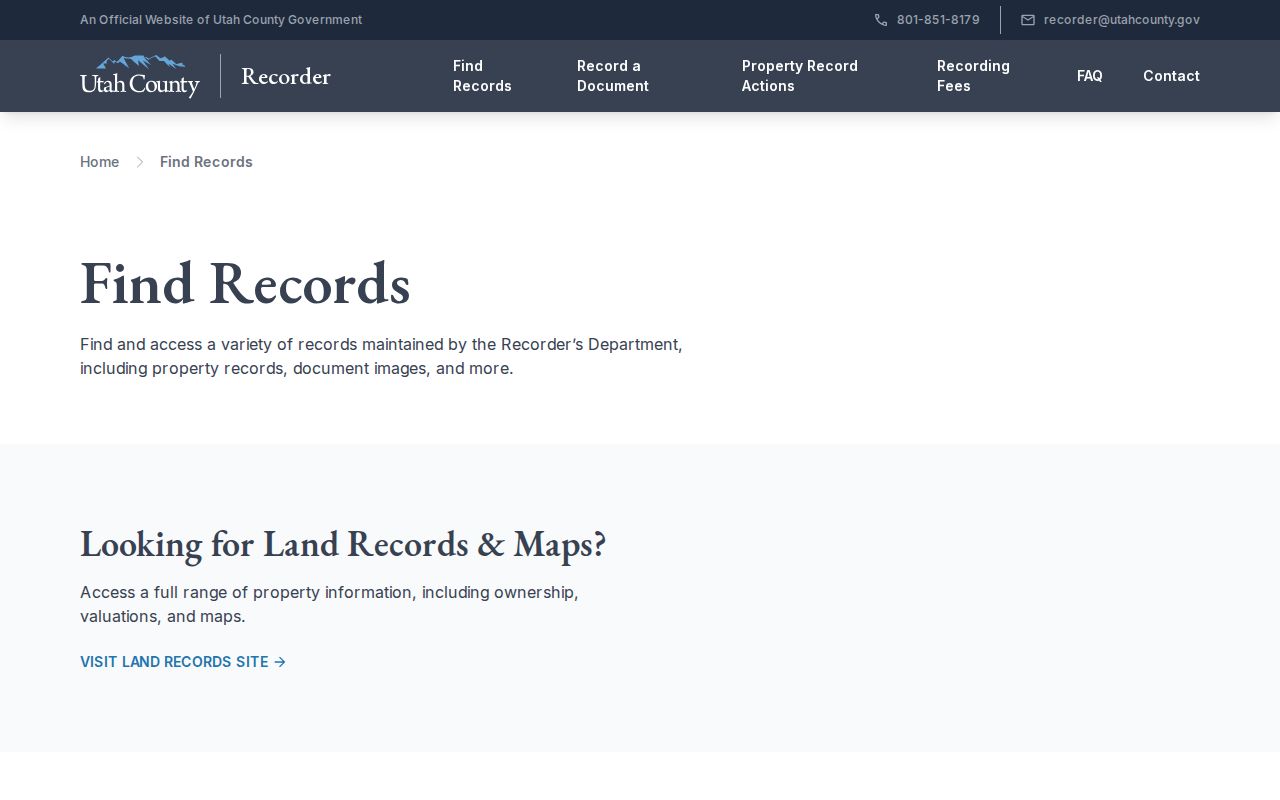
That distinction helps when a free entry points to a document that must be viewed through another link or ordered from the office.
Note: The Recorder does not prepare legal documents, interpret them, or promise a public title search, so classify each instrument yourself.
Payson Voter Records With Limits
The Utah Voter Search form asks for first name, last name, date of birth, street address, city, and ZIP. It is intended for a voter checking registration status and polling information. It is not an open street roster. County maps place Payson addresses in precincts 401 through 414, while the County Clerk handles list requests and related forms.
The 2026 voter-file transition makes the access line especially important. The state page describes the current file, fees, tab-delimited delivery, address and district fields, vote history that shows participation rather than choices, and withholding for At-Risk records. It also sets use and disclosure limits. Full birth dates remain restricted. Use the self-lookup for a person’s own status, and use the state or county request route only when the stated purpose and legal conditions fit.
For a voter question, the official election-data instructions explain the difference between a statewide file, who-voted reports, absentee lists, and county products. A GRAMA request cannot override the voter statute or At-Risk designation.
Payson Vital Records Open by Age
Utah birth and death certificates are not open name directories. Birth records become public after 100 years, and death records after 50 years. Current certified copies are controlled by relationship or a direct, tangible, legitimate interest under Utah Code 26B-8-125. The state Office of Vital Records and Statistics and Utah County Health are the current routes, while State Archives and FamilySearch provide older indexes and images.
The Archives death collection generally reaches older material from 1904 or 1905 through 1970, with browse and description paths and a separate 1971 to 1975 index. The index can include a name, death date, county number, gender number, and state file number. Payson Cemetery’s deceased-record PDF supplies surname, birth date, death date, and lot or section clues, but a burial is not proof of residence.
Marriage records add another family-history route. FamilySearch identifies Utah County marriage records from 1871 through 1941, with spouses, officiator, witnesses, dates, ages, and residences where recorded. The state form describes generally available marriage or divorce records from 1978 through 2010 and later limits. Check the issuing office and fee before sending a request because the state and county schedules differ.
Historic Payson Resident Directories
Older Payson residents directory work begins with the collections, not with a current name search. R.L. Polk & Co.’s Provo City and Utah County Directory includes a Payson section, with finding-aid leads for 1891, 1901–02, 1904–05, and 1911. A separate Utah City Directories collection has a 1973 Payson lead in an image set. These are confirmed year leads, not a claim of an unbroken annual run.
Directories can show a name, occupation or role, street address, and household qualifier. Marks such as r for residence and bds for boarding help read an entry, but a directory listing is a publication snapshot rather than proof of ownership or continuous residence. The full collection method belongs on the Payson city directory page, where the library, Marriott Digital Library, FamilySearch Center, newspapers, yearbooks, and Historical Society routes are set out.
Payson Uses More Than One Street Name
A Payson search can fail when the place is right but the street label is not. City materials show Utah Avenue as 100 N, 900 N alongside 9600 S in the broader county grid, 700 N with Arrowhead Trail, and 200 S with 10400 S. Main, American Way, numbered streets, plats, blocks, and legal descriptions can each describe the same built setting from a different record system.
Normalize an old address through the city map, zoning or General Plan material, Parcel Map, plat, and Recorder legal description. Haskellville adds a jurisdiction test: the East Side Comprehensive Plan identifies it as unincorporated Utah County between Salem and Payson, mostly agricultural with private residences. A nearby place may use a Payson mailing label while remaining outside the incorporated line. That is why a city directory, deed, and ZIP search must be compared rather than merged by name alone.
Payson ZIP 84651 Delivery Geography
Payson’s primary postal ZIP is 84651, served by the Payson Post Office at 955 E 100 N. Utah’s official ZIP-by-county table also associates 84651 with Elk Ridge and Spring Lake. Salem is associated with 84653. These links describe postal geography, not a city-limit map, and they do not turn a ZIP result into a resident roll.
Use USPS address validation for delivery questions and Utah County GIS for the municipality and parcel. The county address form has no ZIP field, and the Parcel Map’s inspected controls search address, serial, owner, PLSS, or city instead. Once a ZIP narrows the question, a full address or parcel serial is still needed for the county record chain.
Payson Cemetery as a History Clue
The Payson Cemetery at 400 N 800 E is both a civic facility and a useful historical index. Its 397-page deceased-record PDF, dated July 2, 2024, is surname-indexed and includes names, birth dates, death dates, and lot or section markers. A row can lead to a newspaper notice, directory year, deed, or family record without claiming that burial proves a person lived in Payson.
The city cemetery record is especially useful when a family name has an approximate date but no street. The sexton’s plat and city cemetery office remain the better route for a lot question. Keep burial, residence, and ownership as separate facts.
Payson GRAMA When Online Search Stops
GRAMA is the fallback for a specific Payson City or Utah County record that is not posted. Utah Code Title 63G, Chapter 2 requires a written request with the requester’s name, mailing address, a phone or email when available, and a reasonably specific description. Filing is free. Inspection is free, while copies and allowed staff work can carry actual costs. An estimate above $50 may require prepayment, and a public-benefit waiver is not automatic.
Utah County Property Watch is a free alert layer for deed and lien activity. A subscriber can use a parcel serial or a name or business and receive an email when recorded activity appears. The county says the service is not a fraud-prevention guarantee. Treat an alert as a prompt to inspect the official Recorder entry, not as proof that a transfer is wrong or that a person lives at the parcel.
For a Payson property concern, save the alert, compare the entry and year, follow any tie or release, and contact the Recorder through its published number or email. The alert service and the public index serve different roles: one signals change, while the other supplies the record trail. The Utah County Property Watch route explains the subscription path.
Name the office that controls the record. Ask Payson for a dated annexation petition, council packet, permit, or easement file. Ask Utah County for an entry, plat, deed, or election record. The county form lets the requester identify the office, describe the record, choose inspection or copies, and authorize an estimate. If a series is older, ask the State Archives, Payson Library, FamilySearch Center, or Historical Society which collection should be checked before sending a request.
Here is the Payson City GRAMA route, followed by the city screenshot that documents the municipal request path.
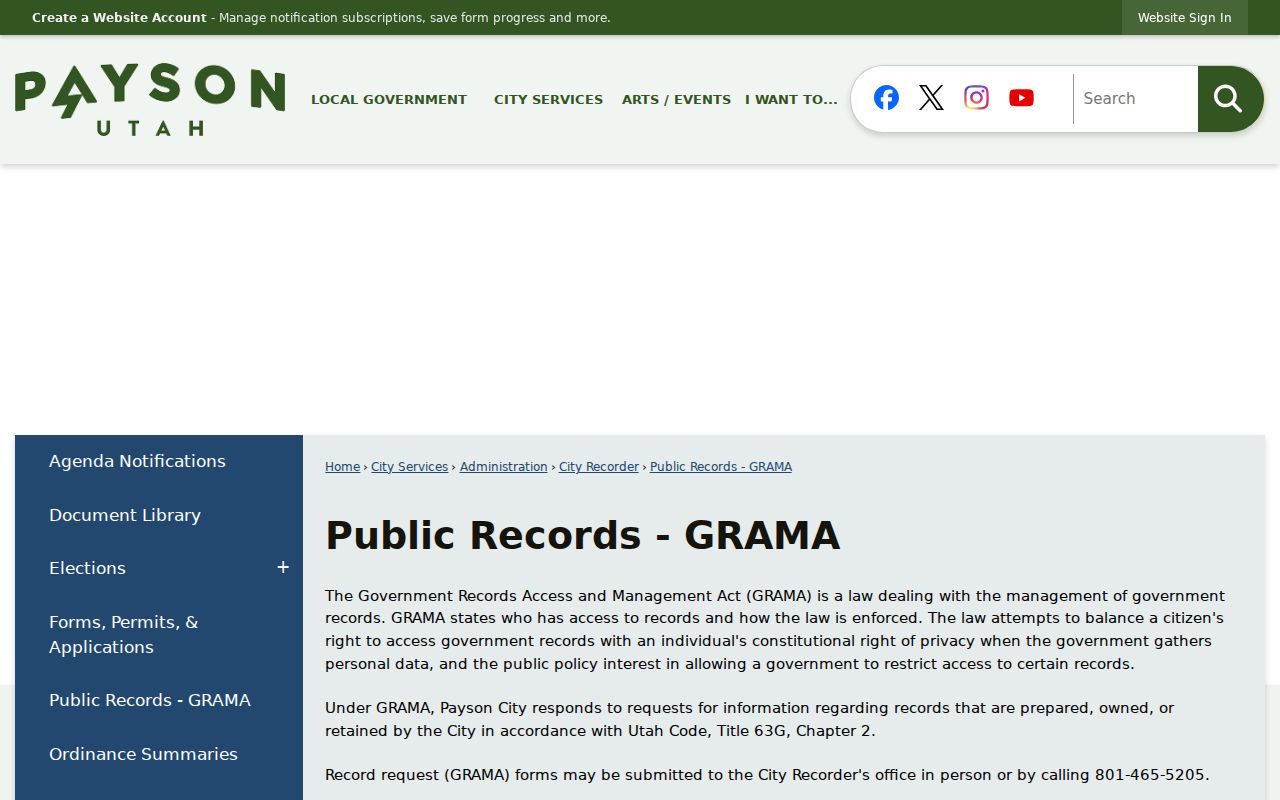
The city route keeps a local request with the local custodian. A county request follows the county form, while the State Archives guide explains appeal and older transferred records.
The Utah County GRAMA form shows the county-side choices for an office, record description, inspection, copies, and estimated cost.
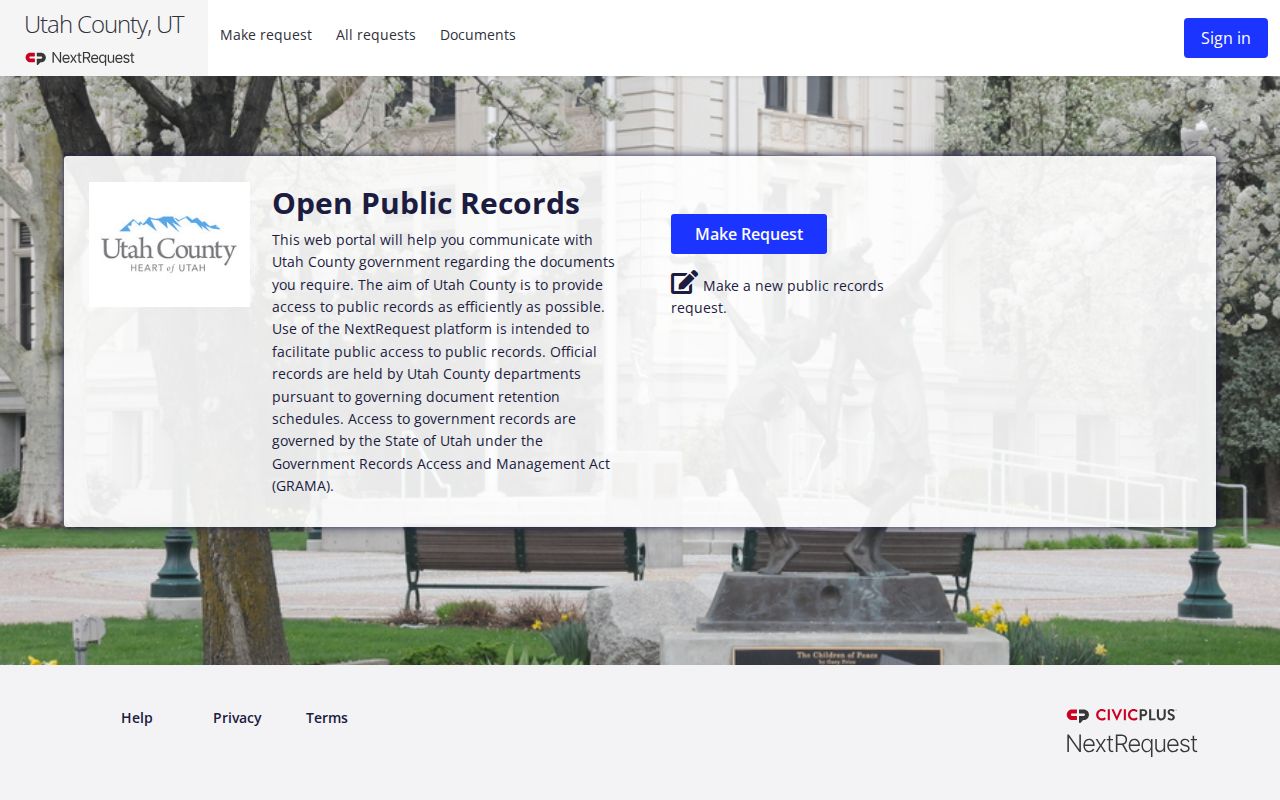
Keeping the request with the named custodian reduces delay and makes the response easier to match to the record series requested.
Payson Sources Beat Quick Matches
A commercial people-finder category may return a fast name match, but it can blend people, lag behind changes, and offer no county context. Official sources are slower and narrower, yet each states what its record means. The difference matters when a researcher is tracing kin, checking a seller’s public filing, reconnecting with an old classmate, or preserving a house history.
The Utah Courts Xchange landing screen illustrates a separate path for case information, with guest search and account choices rather than a resident roll.
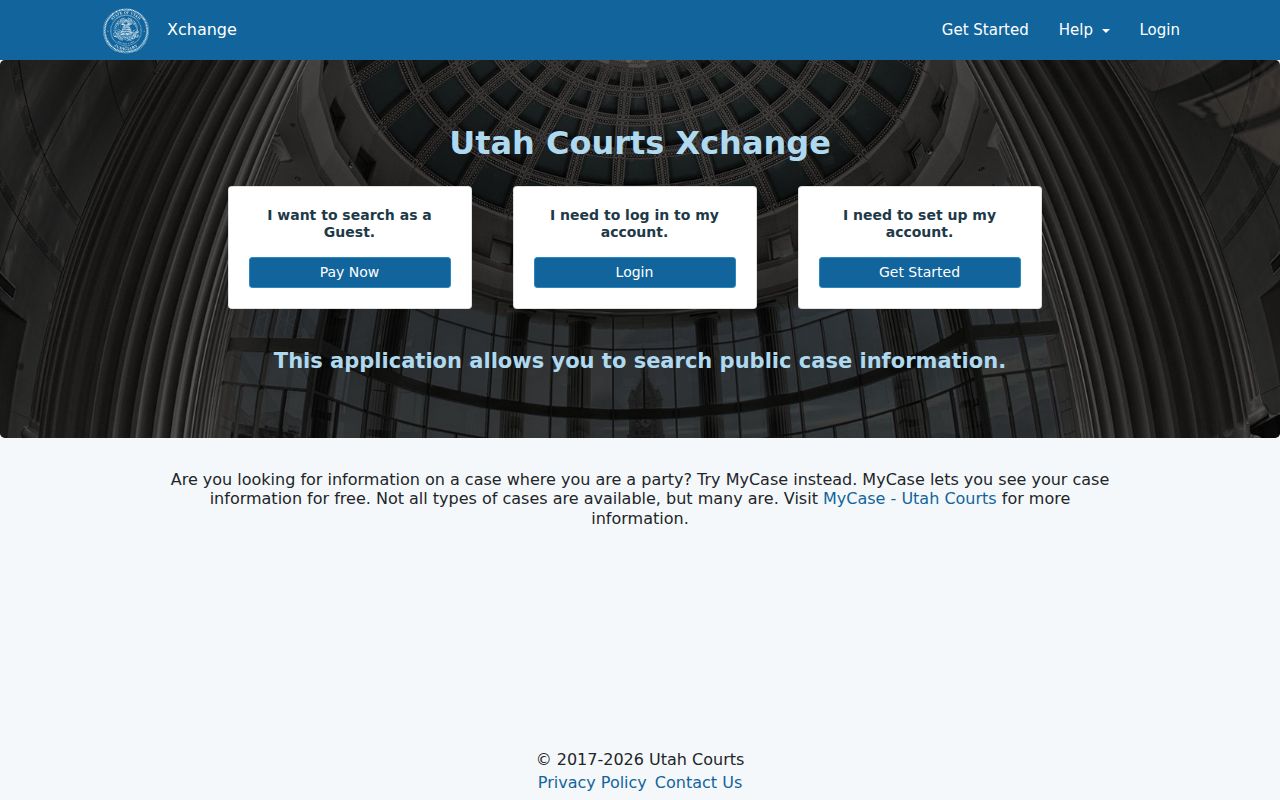
Use a court portal to answer whether a party or case event is indexed, then read the case history and privacy limits before drawing any conclusion about a person.
| Route | Strength | Limit |
|---|---|---|
| County index | Named parcel, entry, serial, and legal trail | Owner or party is not automatically an occupant |
| State self-lookup | Direct registration and polling check | Self-use and election rules apply |
| Library or archive | Dated family and place context | Runs, scans, and access vary |
| Commercial category | May combine many public and private data points | Source meaning, freshness, and lawful use are unclear |
- Roll
- A list kept for a defined purpose, such as taxes or elections.
- Index
- A finding aid that points to a record; it is not always the record image.
- Parcel
- A mapped unit of land identified by a county serial.
- Criss-cross directory
- A reverse directory arranged by address rather than only by surname.
Use the source that matches the question, then confirm with a second record whose date and purpose differ. That habit keeps the Payson residents directory useful without turning separate public records into an invented list.
For a business or principal name, the Utah Division of Corporations search route can point to entity status, filing history, principals, UCC, or certification options.
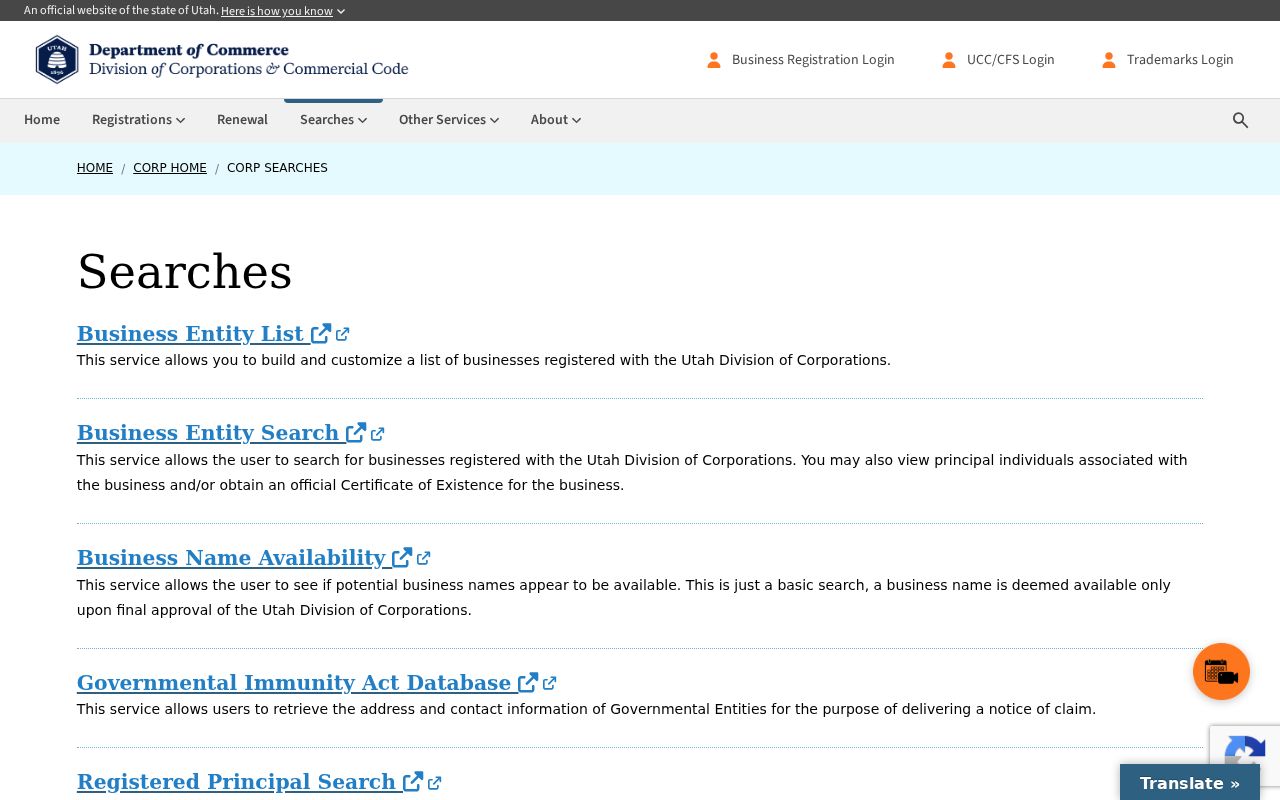
That state search is a business-record route, not proof that a principal lives at the entity’s address.
Federal case questions belong with PACER and the District of Utah. The federal access screen is separate from Utah Courts and follows its own redaction rules.
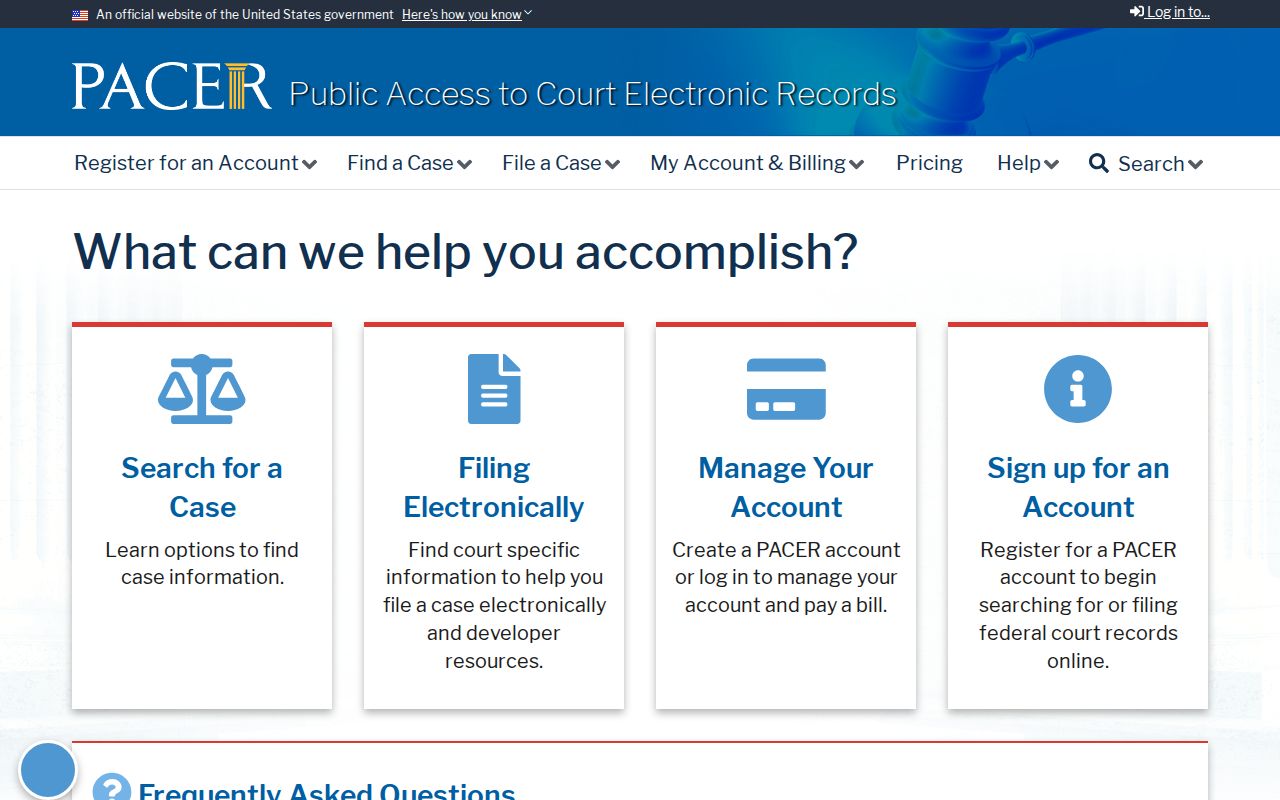
A PACER result can establish a federal case record within public access limits, not a current Payson residence.
Privacy Limits in Payson Records
Utah records have clear boundaries. GRAMA classifications can make a record private, protected, controlled, or sealed. Xchange omits sealed, juvenile, adoption, expunged, and other protected matters. Vital access depends on age, relationship, or legitimate interest. Voter data has purpose and disclosure limits. Safe at Home and At-Risk designations can withhold or replace an actual address.
Lawful personal use. Payson public records are for lawful research, family history, civic understanding, and other legitimate personal purposes. Do not use a name, address, voter record, court result, or alert to stalk, harass, intimidate, or harm another person.
Utah Safe at Home provides a substitute address and mail forwarding for eligible participants facing domestic violence, abuse, stalking, human trafficking, or sexual assault. Do not reverse a substitute address through a parcel, voter, directory, or municipal record. A missing result may reflect protection, not absence.
Recent Payson Records Changes
Payson’s record landscape is still moving. Clearwing annexation material filed January 2, 2025 concerns about 29.874 acres near 3751 W 9600 S and references earlier R&C #2 and Pace Industrial Park entries. A 2025 Utah County Recorder digitization procurement records bids and evaluation activity, but does not promise a finished public interface or a particular completion date.
The 2026 voter-file changes make self-lookup and public election data even more distinct. Payson Library and the FamilySearch Center also promote local digitization and family-history help, including Memory Lane equipment for tapes, photographs, slides, books, and home movies. These efforts can fill a gap between a public deed, an old directory, and a family-held clue, while official custodians remain the place to verify a record.
For a court question, use official Xchange or PACER routes and watch for the District of Utah’s warning about fake payment texts and websites. For a property question, verify every alert or search result against the Utah County Recorder. The strongest directory work remains dated, source-labeled, and careful about what each record can actually prove.
Note: The research found no courthouse fire or specific local record loss, so an unavailable image should be tested through alternate offices before being called destroyed.